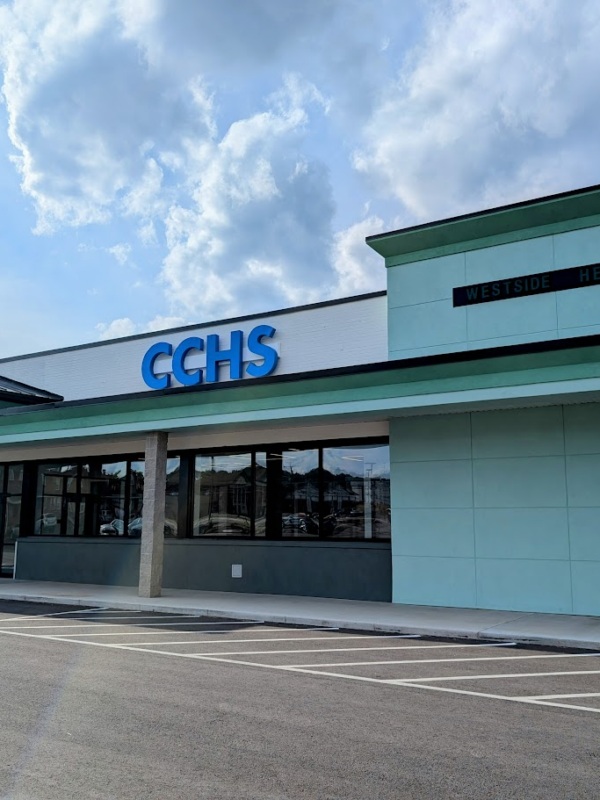
Cabin Creek Health Systems is a Federally Qualified Health Center providing clinic-based and school-based healthcare across Kanawha County in West Virginia. Charleston’s west side—far from the more prosperous areas closer to the seat of government—bears the scars of post-industrial decline, with vacant buildings standing as reminders of lost economic opportunity.
Cabin Creek had been providing mobile health services, but its impact was constrained by limited operating hours and the patient-visit capacity of its mobile van. More importantly, the mobile model revealed unmet need extending far beyond the unhoused population to the broader community of residents who lacked reliable transportation to healthcare providers.
The health center needed to expand with a permanent location where they could provide comprehensive services the community otherwise couldn’t access. Yet traditional commercial banks face significant barriers when financing community health center projects: nonprofits don’t fit conventional lending models, and the complex revenue streams of FQHCs—mixing commercial insurance, Medicaid reimbursements, and the 340B Drug Pricing Program—require specialized understanding that most commercial banks simply don’t have.
PCDC provided more than just capital. We brought expertise that Cabin Creek needed to successfully execute their first real estate project of this scale. Our $3.5 million loan gave Cabin Creek the financial foundation to move forward, which they combined with $1 million in grants and cash to complete the renovation.
The technical assistance we provided during underwriting and closing proved invaluable. The health center’s leadership team had not navigated a construction project of this size, so PCDC worked closely with them to develop a comprehensive construction budget accounting for costs beyond the general contractor’s price—including legal fees, closing costs, insurance, and interest carry during construction. This hands-on guidance ensured realistic financial projections and prevented unexpected shortfalls mid-project.
Services at Cabin Creek have rolled out progressively, with significant numbers of new patients demonstrating the unmet need for medical and behavioral health care in the neighborhood:
Since opening in 2024:
Wraparound services provided:
The addiction services are particularly noteworthy for their culturally responsive approach. Rather than relying solely on traditional 12-step programs, Cabin Creek developed alternative recovery pathways that better serve their patients, including a dedicated recovery group meeting room designed with privacy-preserving architecture.
Perhaps most significantly, the steady flow of patients, staff, and visitors is beginning to change the neighborhood’s trajectory. In post-industrial cities struggling to reinvent themselves, a thriving community health center can be the anchor that helps revitalize an entire area—proof that patient CDFI capital combined with deep community expertise creates transformation beyond healthcare access alone.